Consulting
Service
A shaftless screw conveyor is a continuous conveying device that eliminates the need for a traditional rigid central shaft. It relies on the friction and pushing force between the shaftless screw blades and the conveying trough to transport materials. It is widely used in conveying easily entangled, easily clogged, and highly viscous materials such as municipal sludge, kitchen waste, construction waste, and viscous chemical materials. It is a core component in material handling systems in industries such as environmental protection, metallurgy, food, and building materials. Compared to traditional shafted screw conveyors, its innovative structural design significantly improves its adaptability and conveying efficiency, making it the preferred equipment for material conveying under complex working conditions. The following will elaborate on its working principle, core features, and applicable scenarios, providing a comprehensive analysis of the technical characteristics and application value of shaftless screw conveyors.
A. Core Working Principle of Shaftless Screw Conveyor
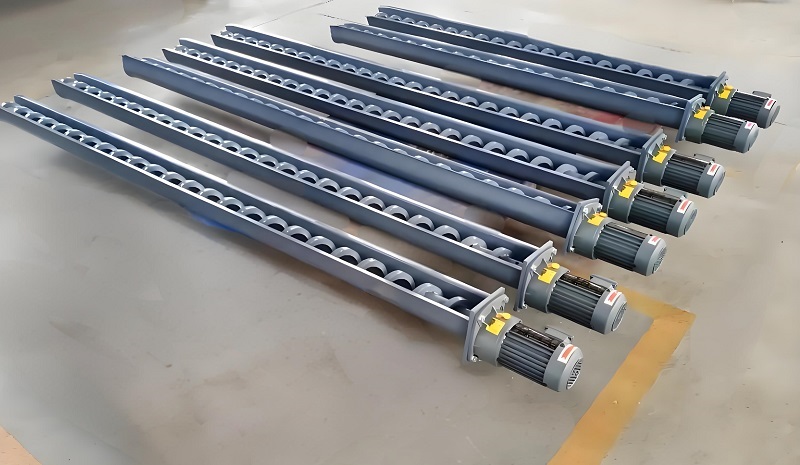
The working principle of a shaftless screw conveyor is based on the rotational pushing force of the screw blades and the internal and external friction effects of the material. Its overall structure mainly consists of shaftless screw blades, a U-shaped conveying trough, a drive unit, a head bearing, a tail tensioning device, and a base. The core transmission logic is: "The drive unit drives the screw blades to rotate—the blades generate axial pushing force on the material—the material overcomes frictional resistance to achieve axial movement." The specific working process can be divided into three key stages, each cooperating with the others to ensure continuous and stable material conveying.
1. Power Transmission and Blade Rotation Stage: The drive unit (usually a geared motor) is connected to the head of the shaftless screw blades via a coupling. The geared motor converts the high-speed, low-torque motor power into low-speed, high-torque output power, driving the shaftless screw blades to rotate at a uniform speed within the U-shaped conveying trough. The shaftless helical blades are made of continuous rolled steel strips or welded steel plates. The absence of a central shaft makes them flexible. A tensioning device at the tail adjusts the blade tension, preventing slippage and misalignment during rotation, while maintaining a proper clearance between the blades and the inner wall of the conveying trough, providing a stable power foundation for material conveying.
2. Material Force and Motion Trend Formation Stage: When material falls from the conveyor's inlet into the U-shaped conveying trough, it accumulates in the gap between the rotating shaftless helical blades and the trough. The rotating helical blades exert forces on the material in two directions: a circumferential tangential force, attempting to rotate the material with the blades; and an axial pushing force, determined by the helix angle of the helical blades, which is the core driving force for axial movement of the material. Simultaneously, there is external friction between the material and the inner wall of the conveying trough, and internal friction between the material particles. These two frictional forces hinder the material's circumferential rotation with the blades. When the axial pushing force exceeds the total frictional resistance, the material will overcome the circumferential rotation tendency and move axially along the helix angle of the helical blades.
3. Continuous Material Conveying and Unloading Stage: Under the continuous rotation of the helical blades, the axial pushing force continuously acts on the material, forming a continuous material flow within the conveying trough, moving at a uniform linear speed from the inlet to the outlet. During the conveying process, the continuous structure of the shaftless helical blades generates a certain degree of stirring and pushing effect on the material. Even highly viscous and easily agglomerated materials can be broken up by the blades and pushed forward, preventing material accumulation within the conveying trough. When the material reaches the outlet at the head of the conveyor, under the combined action of centrifugal force and axial pushing force, the material detaches from the helical blades and is smoothly discharged from the outlet, completing the entire conveying process.
The conveying speed and conveying capacity of the shaftless screw conveyor can be precisely controlled by adjusting the speed of the drive unit. With a geared motor and a frequency conversion control system, the speed can be adjusted in real time according to the upstream material supply and the downstream equipment processing capacity, achieving intelligent matching of material conveying and preventing material overflow or interruption. Meanwhile, the inner wall of the U-shaped conveyor trough is usually lined with wear-resistant plates (such as polyurethane or stainless steel plates), which effectively reduces the frictional resistance between the material and the trough, reduces equipment wear, and improves conveying efficiency.
B. Core Features of Shaftless Screw Conveyors
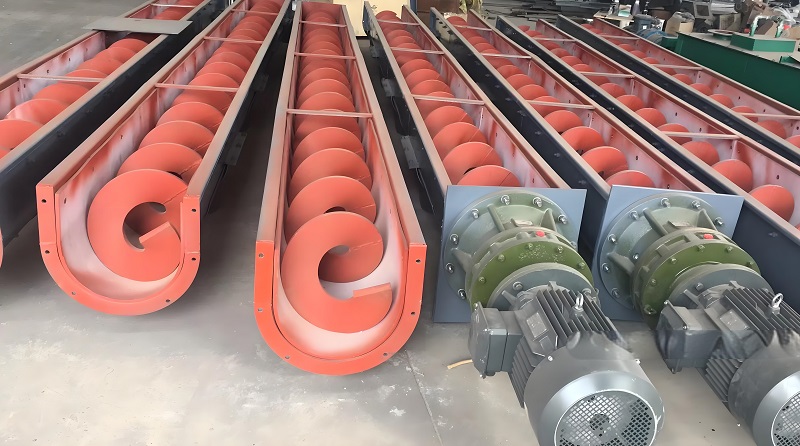
Shaftless screw conveyors, with their innovative structure of having no central shaft, exhibit significant advantages over traditional shafted screw conveyors in terms of material adaptability, equipment reliability, and ease of maintenance. However, they also have certain technical limitations, which can be divided into advantages and limitations, analyzed in detail below to provide a comprehensive reference for equipment selection and application.
1. Core Advantages and Features of Shaftless Screw Conveyors
a. Anti-entanglement and anti-clogging, suitable for conveying complex materials
This is the core advantage of shaftless screw conveyors. Traditional shafted screw conveyors are prone to entanglement of fibrous or ribbon-like materials (such as plastic fibers in sludge, cling film in kitchen waste, and straw), causing the material to become stuck on the shaft and blades, leading to equipment shutdown or even motor burnout. Shaftless screw conveyors eliminate the central shaft; the continuous spiral blades have no protrusions or connecting parts. There are no entanglement points during material conveying. Even fibrous, viscous, and easily agglomerated materials can move smoothly under the pushing force of the blades, significantly reducing the probability of material blockage and entanglement. At the same time, the large opening design of the U-shaped conveying trough facilitates manual cleaning. If a small amount of material accumulates, the trough cover can be quickly opened for cleaning, greatly improving maintenance convenience.
b. Simple structure, high operational reliability, and low failure rate. The shaftless screw conveyor has far fewer parts than the shafted screw conveyor, eliminating vulnerable components such as the central shaft, bushings, and intermediate bearings. This results in a simpler overall structure and fewer potential failure points. Traditional shafted screw conveyors have intermediate bearings that are in constant contact with materials, making them susceptible to wear and corrosion, requiring frequent replacement. In contrast, the shaftless screw conveyor only has a bearing at the head and a tensioning device at the tail. Furthermore, the head bearing is located outside the material conveying channel and has no direct contact with the material, effectively preventing wear and corrosion. This significantly improves the equipment's operational stability and service life. Under 24-hour continuous operation conditions, such as in municipal sludge treatment, the average mean time between failures (MTBF) of the shaftless screw conveyor can reach over 8000 hours, far exceeding that of shafted screw conveyors.
c. Excellent Sealing and Environmental Friendliness: The U-shaped conveying trough of the shaftless screw conveyor features a fully enclosed design. A sealing cover (such as fiberglass or stainless steel) can be fitted above the trough, and a sealing strip seals the connection between the cover and the trough, effectively preventing dust, odor diffusion, and material leakage during material transport. In scenarios with high environmental requirements, such as transporting kitchen waste, municipal sludge, and toxic chemical materials, it effectively avoids pollution to the surrounding environment and meets national environmental emission standards. Simultaneously, the sealed design prevents external impurities from entering the conveying trough, ensuring material purity.
d. Flexible Conveying, Adaptable to Small Curvature Turns: The shaftless screw blades have a continuous, flexible structure without the rigid constraint of a central shaft, allowing it to be designed as a turning shaftless screw conveyor. It adapts to turns with small radii of curvature (typically 1.5-3m), enabling flexible placement in confined workshops and factories. The elimination of intermediate transfer equipment reduces material transport links, lowering equipment investment and floor space requirements. Traditional shafted screw conveyors, limited by the rigidity of their central shaft, cannot achieve turning conveying. Changing the material conveying direction requires a transfer hopper and multiple conveyors, increasing system complexity and operating costs.
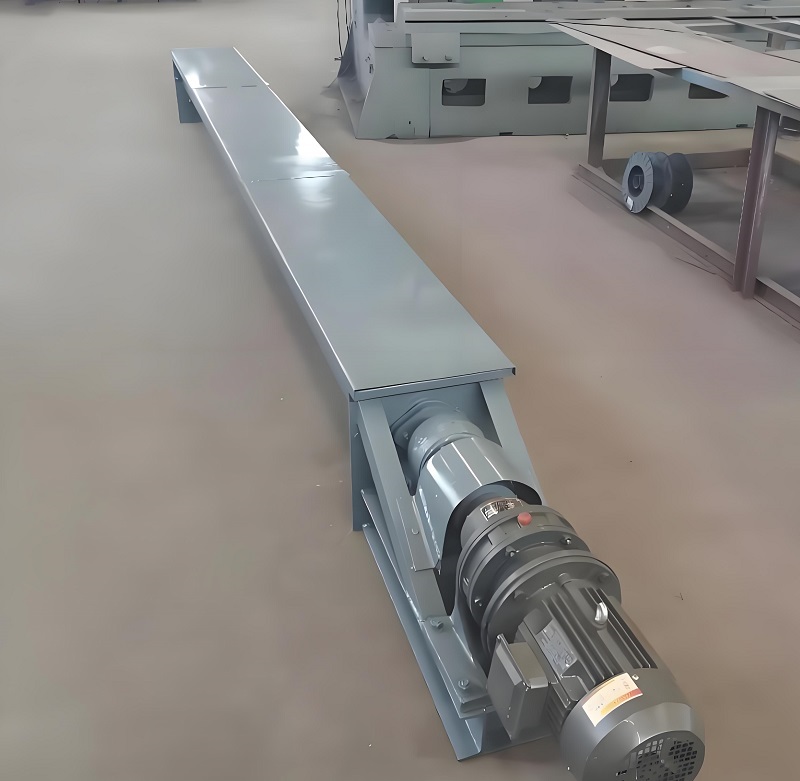
e. Low wear, low maintenance costs, and long service life: Shaftless screw conveyors typically use high-strength wear-resistant alloy steel (such as Mn13, 304 stainless steel with wear-resistant weld overlay), achieving a surface hardness of HRC50 or higher, providing excellent wear and corrosion resistance. The polyurethane or stainless steel lining on the inner wall of the U-shaped conveying trough has a low coefficient of friction and high wear resistance, effectively reducing wear between the material and the trough/blades. Furthermore, the only vulnerable parts are the screw blades and lining, and replacement is simple, requiring no disassembly of the complex shaft and bearings. Ordinary maintenance personnel can perform replacements, significantly reducing maintenance costs and downtime. In addition, the drive and tensioning devices have simple structures, requiring only simple maintenance such as adding lubricant and adjusting tension, greatly reducing maintenance workload.
f. Smooth conveying process and low material breakage rate
The shaftless screw conveyor's helical blades rotate at a relatively slow speed (typically 5-30 r/min), resulting in smooth material movement within the conveying trough without severe impacts or collisions. Furthermore, the reasonable gap between the blades and the conveying trough prevents material compression and breakage. For scenarios requiring material integrity (such as viscous materials in the food industry and granular materials in the building materials industry), this effectively reduces material breakage rates and ensures the quality of subsequent processing. Simultaneously, the smooth conveying process reduces equipment vibration and noise; the noise level during operation is generally below 65 dB, improving the workshop working environment.
2.Technical Limitations of Shaftless Screw Conveyors
a. Limited conveying distance and lifting height
Because the shaftless screw blades lack a central shaft for support, their rigidity is relatively poor. As the conveying distance increases, the blades are prone to bending and deformation, leading to uneven gaps between the blades and the inner wall of the conveying trough, affecting conveying efficiency, and even causing blade jamming. Currently, the horizontal conveying distance of conventional shaftless screw conveyors is generally no more than 30m, and the vertical lifting height is generally no more than 6m. For long-distance, high-height conveying, multiple conveyors need to be connected in series, increasing system complexity. In contrast, the central shaft of a traditional shafted screw conveyor provides reliable support for the blades, allowing for horizontal conveying distances exceeding 50m and vertical lifting heights exceeding 10m, making it more advantageous in long-distance conveying scenarios.
b. Relatively Smaller Conveying Capacity: The cross-sectional area of the helical blades of a shaftless screw conveyor is smaller than that of a shafted screw conveyor of the same specifications (due to the absence of a central shaft occupying space, but the blade width is limited by the trough). Furthermore, to avoid blade deformation, its rotational speed should not be too high. Therefore, the conveying capacity of a shaftless screw conveyor of the same specifications is slightly lower than that of a shafted screw conveyor. The conveying capacity of a conventional shaftless screw conveyor is generally 1-100m³/h, while that of a shafted screw conveyor can reach 5-200m³/h. In scenarios involving large-capacity, conventional material conveying, shafted screw conveyors offer better cost-effectiveness.
c. Relatively High Energy Consumption: The material conveying in a shaftless screw conveyor relies primarily on the friction between the blades and the material. To overcome this frictional resistance, a higher torque output is required. Therefore, for the same specifications and conveying capacity, the energy consumption of a shaftless screw conveyor is slightly higher than that of a shafted screw conveyor. However, in scenarios involving highly viscous or easily entangled materials, shaftless screw conveyors can avoid energy waste caused by equipment blockages and downtime, resulting in lower overall energy consumption.
d. High Requirements for Blade Material and Manufacturing Process: The shaftless screw blades are the core component of the equipment. Their manufacturing process directly affects the operational stability and service life of the equipment. Continuous screw blades require high-precision rolling or welding processes to ensure uniform helix angle and a smooth surface. Insufficient manufacturing precision can lead to uneven stress during rotation and blade deformation. Furthermore, the blades need to be made of high-strength, wear-resistant alloy steel, resulting in relatively high material costs and a higher initial investment cost for shaftless screw conveyors compared to shafted screw conveyors of the same specifications.
C. Applicable Scenarios and Industry Applications of Shaftless Spiral Conveyors
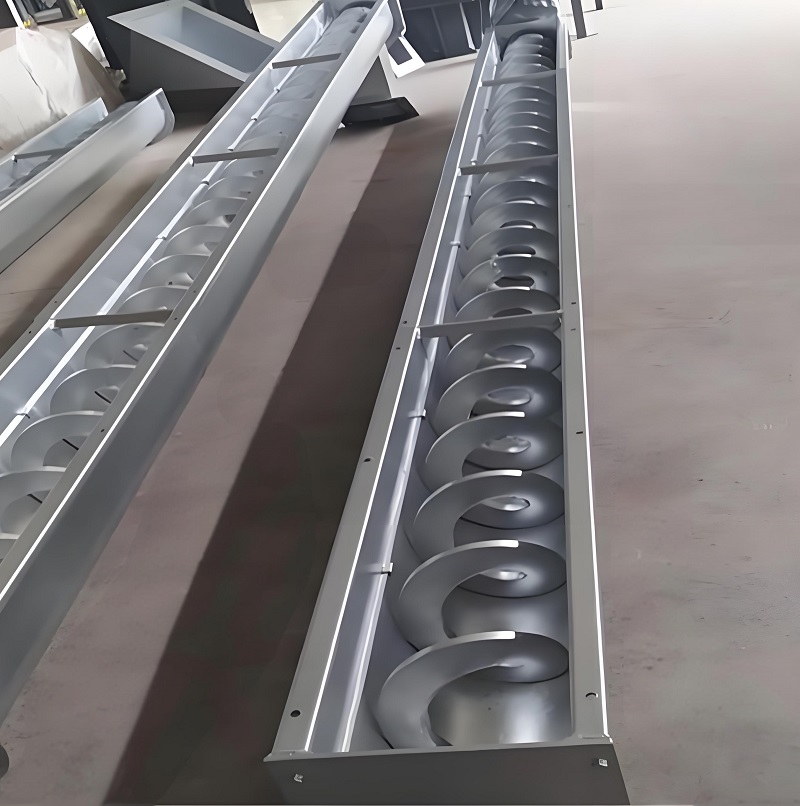
The characteristics of the shaftless screw conveyor determine its primary suitability for conveying materials prone to tangling, high viscosity, easy clumping, and high impurity content. It is also suitable for applications with limited space or requiring curved conveying. Its application industries and specific materials include environmental protection, metallurgy, food, building materials, chemical industry, and more, making it a key equipment in multi-industry material handling systems
1. Environmental Protection Industry: Municipal sludge (domestic sludge, industrial sludge), food waste, kitchen waste, construction waste, domestic waste, leachate sludge, etc., are the most widely applied sectors for screw conveyors without shafts, and they serve as core supporting equipment in municipal wastewater treatment plants, waste incineration plants, and solid waste treatment centers;
2. Food Industry: Food processing waste, fruit and vegetable residues, flour residue, sticky sauces, slaughter waste, etc., meeting the requirements for equipment sealing and hygiene in the food industry;
3. Metallurgical Industry: Metallurgical slag, iron powder, tailings, and metallurgical waste materials exhibit wear-resistant and corrosion-resistant properties, making them suitable for the harsh working conditions in the metallurgical sector;
4. Building Materials Industry: Cement clinker, fly ash, construction waste soil, ceramic clay, gypsum powder, etc., suitable for conveying in small-radius turns and adapting to the confined spaces of building material factories;
5. Chemical Industry: For viscous chemical materials, chemical waste residues, paint raw materials, fertilizer pellets, etc., the sealing design effectively prevents the volatilization and leakage of chemical substances, avoiding environmental pollution;
6. Agricultural Industry: Straw, hay, feed raw materials, farm manure, grain residues, etc. The anti-entanglement design effectively prevents the entanglement of fibrous agricultural materials, ensuring smooth conveying.
The shaftless screw conveyor, as an innovative continuous conveying device, breaks the application limitations of traditional shafted screw conveyors through its centerless structural design. Its core advantages—anti-wrapping, anti-blocking, excellent sealing, and reliable operation—make it the preferred equipment for conveying complex materials with high viscosity, prone to tangling, and containing impurities. Particularly in the environmental protection industry, it plays an irreplaceable role in sludge and waste treatment. Despite its limitations, such as limited conveying distance, relatively small capacity, and high initial investment, these technical shortcomings can be effectively mitigated through methods like tandem arrangement, variable frequency speed control, and optimized blade material selection, thereby meeting conveying requirements under diverse working conditions.
With the rapid development of the environmental protection industry and the increasing demands for material handling efficiency and environmental compliance across various sectors, the technology of shaftless screw conveyors continues to innovate. Applications such as large-radius curve design, high-strength lightweight blades, intelligent tensioning systems, and remote monitoring fault prediction will further enhance their conveying performance, intelligence level, and service life. In the future, shaftless screw conveyors will be widely adopted in complex material handling scenarios across more industries, becoming an indispensable core component in material processing systems. They will provide robust support for efficient, environmentally friendly, and intelligent production in diverse sectors.


Company: Zhengzhou ZhongCheng environmental protection equipment co., LTD

Company address: 36 xueyuan road, Zhengzhou City, Henan Province, China.

Whatsapp:+86-18738194110


Our Email

Our phone
 86-18738194110
 86-18738194110

Save Time! Get A Detailed Quotation Quickly.


 2024-11-01